Epic Legacy Workshop | Suzanne Luke | TGD
Family history storytelling is the practice of gathering photos, memories, letters, and records, then organizing them into a narrative that preserves identity, context, and relationships. AI can speed organization and drafting, but accuracy and privacy still matter.
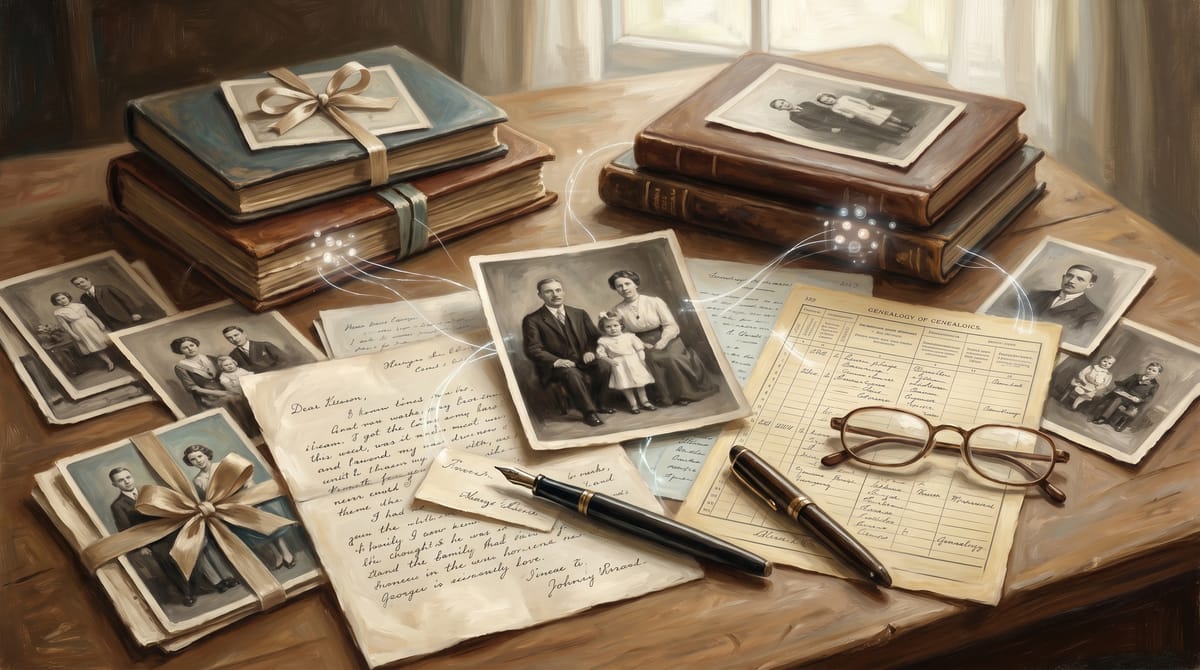
Family history storytelling is the practice of gathering photos, memories, letters, and records, then organizing them into a narrative that preserves identity, context, and relationships. AI can speed organization and drafting, but accuracy and privacy still matter.
Key Takeaways
- Family chronicles work best when you sort memories by person, place, event, or timeline before drafting.
- According to FamilySearch's 2025 Genealogy Highlights, more than 297 million visits and 2.2 billion new searchable names and images show how fast genealogy is growing.
- AI transcription can help with handwritten letters and old records, but every name, date, and relationship still needs human verification.
- Epic Legacy Workshop is a Basic course that turns scattered photos and memories into themes, timelines, and story material.
- The course fits learners who want a guided, AI-assisted workflow for preserving a family legacy as a digital heirloom or book.
Table of Contents
- Understanding Epic Legacy Workshop AI-Crafted Family Chronicles
- Key Concepts and Techniques
- Who Benefits from Learning Family Chronicles?
- What Do Students Say?
- Is This Course Worth It?
- About the Creator
- Essential Family Chronicle Building Blocks
- Watch Before You Enroll
- Frequently Asked Questions
- Conclusion
- Explore More on TGD
Understanding Epic Legacy Workshop AI-Crafted Family Chronicles
Family history storytelling is becoming more accessible and more important. Genealogy now combines massive record collections, AI-powered search, and ethical questions about privacy and accuracy. According to FamilySearch's 2025 Genealogy Highlights, the site received more than 297 million visits and added more than 2.2 billion new searchable names and images. That scale matters because more records mean more chances to connect people, places, and events.
According to FamilySearch's Full-Text Search update, nearly 2 billion images can now be searched through AI-generated transcripts, which helps researchers find names hidden in handwritten or scanned documents. The South Central Chapter of the Association of Professional Genealogists also notes that AI tools can match variant spellings, recognize occupations and locations, and transcribe letters or parish registers. The result is a faster first pass, but not automatic truth. Family history still depends on careful verification, clear sourcing, and respectful handling of sensitive details.
Want to Learn Family Chronicle Storytelling Step by Step?
This course on The Great Discovery covers those fundamentals in a structured, beginner-friendly format.
The Great Discovery (TGD) is a global online course marketplace where creators publish courses and learners discover practical training across business, technology, wellness, and personal growth.
Key Concepts and Techniques
The strongest family chronicle workflows start with structure, not prose. Once memories are grouped into themes, the writing becomes easier and the final archive becomes more useful.
Gather and triage source material
Start with a cache, not a blank page. Put photos, captions, letters, certificates, and oral memories into one inventory so you can see what is factual, what is anecdotal, and what still needs checking.
That early sort saves time later because it prevents you from drafting around missing context. It also makes it easier to spot repeating names, places, and dates that deserve extra verification.
Build a timeline or theme map
A timeline helps reveal cause and effect across a family line. A theme map works when the story is organized around migration, service, recipes, traditions, or other recurring motifs.
Use whichever structure reduces friction. The goal is to make the material legible before you try to make it elegant.
Use AI as a drafting assistant, not an authority
AI can draft scene summaries, extract names from scans, and suggest alternate spellings. The APG South Central Chapter notes that current tools can also recognize contextual clues such as occupations and locations.
The human researcher still has to confirm each claim. That rule matters most when the source material is handwritten, fragmented, or emotionally loaded.
Preserve the result as a digital heirloom
The course description points toward a digital heirloom that can grow into a published book, which is a practical preservation target. A good final format should be easy to share, back up, and extend.
Think in terms of durability, not only presentation. If relatives can open it years later without special software, the project is doing its job.
Who Benefits from Learning Family Chronicles?
This topic helps anyone who wants to preserve family identity in a usable format. It is especially valuable when the raw material exists, but the story does not yet.
Beginners with photos and memories
This is a Basic-level course, so it fits people who have family artifacts but no system for turning them into a story. Because it sits in Communication, Writing, and AI, it gives beginners a practical path instead of a technical one.
If you want a guided first project, Epic Legacy Workshop is a sensible starting point. It can help you move from scattered material to a working outline without inventing your own process.
Parents, grandparents, and legacy planners
Family memory often stalls because people do not know where to begin. A workflow that groups memories into themes or timelines makes the project feel finite, which is important when the goal is to pass something meaningful to children or grandchildren.
The course's emphasis on AI-guided story crafting is useful here because it lowers the friction of drafting. You still make the choices, but the blank page is less intimidating.
Memoir writers and storytellers
Memoir writing improves when the underlying material is organized well. A family chronicle gives you scenes, context, and lineage details that can strengthen a larger personal narrative.
This course can help you turn notes into draft material faster. That makes it a useful bridge between raw memory and a more polished writing project.
Genealogy hobbyists and community archivists
FamilySearch reported more than 297 million visits in 2025 and more than 2.2 billion new searchable names and images, which shows how fast the research surface is expanding. More data helps, but it also creates a storytelling problem: records do not automatically become a narrative.
If you already research ancestors, this course can help you package findings into something others can read. That is the missing layer for many hobbyists who have evidence, but no finished chronicle.
What Do Students Say?
This course is new to the marketplace and hasn't collected reviews yet. Check back after launch for student feedback.
Is This Course Worth It?
Yes, if your main problem is turning family material into a coherent narrative.
Best for: beginners and family caretakers who already have photos, stories, or records and need a guided structure. The Basic level and Writing, Communication, and AI categories match that use case well.
Not for: learners who want advanced genealogical methods, heavy archival theory, or a deep technical AI curriculum. With no reviews yet, the safest expectation is a focused starter course rather than a broadly validated masterclass.
Verdict: It is a strong next step on TGD when you want to move from collecting family memories to shaping them into a durable, shareable chronicle. The course promise is practical, the audience is clear, and the workflow is approachable.
About the Creator
Suzanne Luke created this course.
Courses created: 2
Total learners: 2
Average rating: 0.0
Creator bio: All the AI Tools You Need to Create Your Courses.
View Suzanne Luke's creator page
Essential Family Chronicle Building Blocks
Turning family material into a lasting chronicle depends on a few repeatable steps. These building blocks are useful even if you never take the course.
| Building Block | What It Does | Why It Matters |
|---|---|---|
| Gather materials | Collect photos, notes, letters, captions, and oral stories | Gives the chronicle factual anchors and prevents missing context |
| Sort by theme or timeline | Group items by person, event, location, or era | Reveals the story arc before you start writing |
| Verify details | Check names, dates, and places against records | Reduces errors and keeps the final archive trustworthy |
| Draft with AI prompts | Turn notes into scene summaries or chapter prompts | Speeds first drafts and helps overcome the blank page |
| Preserve the output | Save in a stable digital format and back up sources | Makes the family chronicle easier to share and extend |
These steps match the way the course is framed: collect family material, organize it, use AI to shape the story, and preserve the result as something the family can keep.
Master Family Chronicle Storytelling with Expert Guidance
Suzanne Luke's bio, All the AI Tools You Need to Create Your Courses, points to a creator who works comfortably with AI workflows. This course covers the same building blocks you just saw in the table, with structured lessons that help you collect, sort, draft, and preserve family material.
Enroll in Epic Legacy Workshop: AI-Crafted Family Chronicles →
Watch Before You Enroll
Learn how to become an affiliate on The Great Discovery — the best affiliate program for course creators and marketers in 2026. Start earning commissions by sharing courses you believe in.
Frequently Asked Questions
What is an AI-crafted family chronicle?
It is a family history project that turns photos, memories, letters, and records into a structured narrative or archive. The APG South Central Chapter says AI can help with variant spellings and handwritten material, but the human writer still has to verify facts.
How do you organize family memories into a story?
Group materials by person, event, place, or theme. FamilySearch's AI search tools make research faster, but the story usually becomes clearer when you sort the evidence before drafting.
Is AI reliable for genealogy and family history?
AI is useful for first passes, especially when transcribing scans or surfacing contextual clues. FamilySearch's 2025 responsible-AI panel emphasized accuracy, privacy, disclosure, education, and compliance, which is the right checklist for any family-history project.
What should you verify before publishing a family chronicle?
Check names, dates, places, and relationships against primary or strong supporting sources. That matters because AI can misread handwriting or invent plausible details when context is incomplete.
Who is the TGD course best for?
It is a Basic-level course for beginners who want help collecting family photos and memories, organizing them into themes or timelines, and using AI-guided tools to craft stories. That makes it a good fit for first-time family-history writers.
How can you preserve a family chronicle for the future?
Save it in a durable digital format, back up source files, and keep notes on where each fact came from. The course description points toward a digital heirloom that can later become a published book, which is a useful preservation target.
Ready to Go Deeper?
You have learned how family chronicles depend on source gathering, timeline building, verification, and careful use of AI. This course turns those ideas into a guided project from start to finish.
Start Learning Family Chronicle Storytelling on TGD →
Conclusion
Family history storytelling works best when you treat it like a preservation project, not just a writing exercise. You learned the basics here: gather source material, organize it by timeline or theme, verify the facts, and use AI only as an assistant.
That approach matters now because genealogy research is expanding fast, with FamilySearch reporting more than 297 million visits and more than 2.2 billion new searchable names and images in 2025. If you want a guided next step, start with Epic Legacy Workshop: AI-Crafted Family Chronicles on TGD. It is a practical next move when you are ready to turn raw family material into something durable.
Explore More on TGD
No related courses were listed for this title, so these internal paths are the closest matches.
- Communication courses on TGD
- Writing courses on TGD
- AI courses on TGD
- The Great Discovery homepage
- Suzanne Luke's creator page
Share Your Knowledge on The Great Discovery
Join Suzanne Luke and hundreds of other creators sharing their expertise. Create and sell your own courses on TGD.