
Learn Food & Mood Connection with Terry Thompson | TGD
The food and mood connection describes how eating patterns, gut health, and nutrient quality can influence energy, emotions, and depression risk. Research links ultraprocessed foods with worse mood outcomes and fruit-rich, Mediterranean-style patterns with better mental health signals.
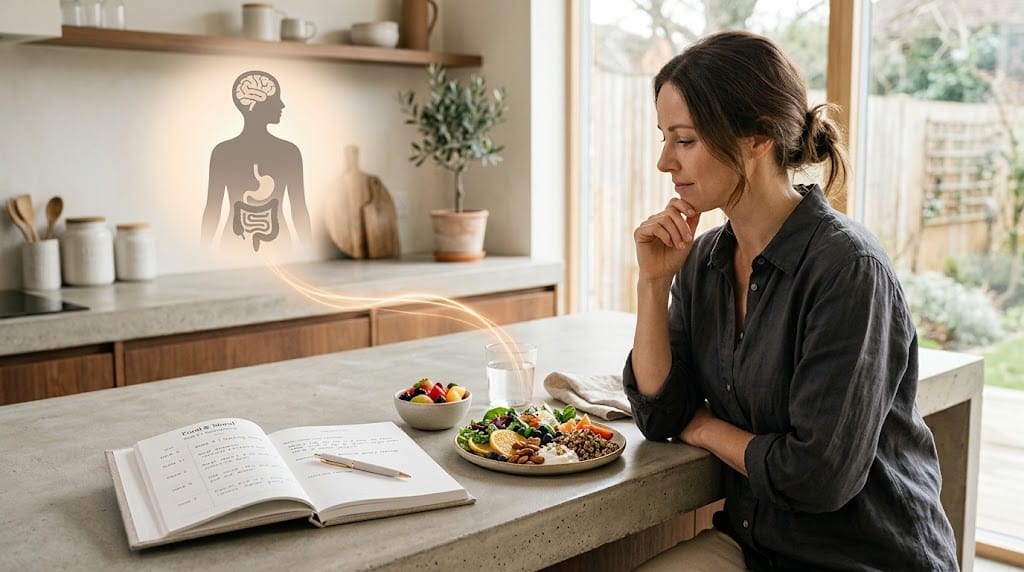
The food and mood connection describes how eating patterns, gut health, and nutrient quality can influence energy, emotions, and depression risk. Research links ultraprocessed foods with worse mood outcomes and fruit-rich, Mediterranean-style patterns with better mental health signals.
Key Takeaways
- The gut-brain axis links diet, the microbiota, and mood through pathways such as the HPA axis and microbial metabolites.
- Harvard Health summarized a study showing that women with the highest ultraprocessed-food intake were 50% more likely to develop depression than those with the lowest intake.
- Harvard Health also reported that higher citrus intake was associated with a 22% lower depression risk over 14 years.
- A Food & Mood Journal helps beginners spot personal triggers by tracking meals, energy, stress, and emotional shifts together.
- Terry Thompson's beginner-friendly TGD course turns this topic into a structured, practical workflow for daily observation.
Table of Contents
- Understanding the Food & Mood Connection
- Key Concepts and Techniques
- Who Benefits from Learning Food & Mood Connection?
- What Do Students Say?
- Is This Course Worth It?
- About the Creator
- Food & Mood Pattern Deep-Dive
- Watch Before You Enroll
- Frequently Asked Questions
- Conclusion
- Explore More on TGD
Understanding the Food & Mood Connection
The food and mood connection is the idea that what you eat can influence how you feel, think, and function across the day. It matters because mood is shaped by more than one nutrient. It reflects food quality, meal timing, gut health, stress load, sleep, and routine.
According to Current Nutrition Reports, the gut-brain axis links diet, the microbiota, and mood through pathways including the HPA axis, tryptophan metabolism, and microbial metabolites such as short-chain fatty acids. According to Harvard Health, women with the highest citrus intake had a 22% lower risk of depression over 14 years, while women who ate the most ultraprocessed food were 50% more likely to develop depression than those who ate the least. A 2026 review in Nutrition also found that Mediterranean-style eating is the most mapped pattern for depressive outcomes and that digital lifestyle tools are becoming more common. That makes this topic practical, not abstract.
Want to Learn Food & Mood Connection Step by Step?
This course on The Great Discovery covers the core ideas in a structured format, with practical guidance you can apply to daily meals and mood tracking.
The Great Discovery (TGD) is a global online course marketplace where creators publish courses and learners discover practical training across business, technology, wellness, and personal growth. It is designed to help learners find structured next steps from independent creators.
Key Concepts and Techniques
The most useful way to study food and mood is through patterns, not isolated meals. That means tracking what you eat, how you feel, and what changes when you adjust one variable at a time.
The gut-brain axis
This is the communication network between the digestive system, the microbiota, and the brain. According to Current Nutrition Reports, it helps explain why probiotics, prebiotics, psychobiotics, and microbial metabolites matter for mood regulation.
Food and mood journaling
A simple journal turns vague feelings into evidence. The course's Food & Mood Journal idea is especially useful for beginners because it helps you notice whether energy crashes, irritability, or focus dips follow specific meals or timing.
Reduce ultraprocessed load
Harvard Health summarized a study where the highest ultraprocessed-food group had a 50% higher depression risk than the lowest group. The practical move is not perfection; it is replacing one or two daily convenience foods with more minimally processed options.
Pattern-based eating
A 2026 Nutrition review highlighted Mediterranean-style eating as the most mapped pattern for depressive outcomes. That does not make it magic. It does suggest that meals built around vegetables, legumes, fruit, fish, olive oil, and whole grains deserve attention.
Run small experiments
Change one variable for one to two weeks, then record what shifts. This method makes the topic actionable and keeps you from overreacting to one bad day.
Who Benefits from Learning Food & Mood Connection?
This topic is most useful for people who want a practical, low-friction way to connect daily habits with how they feel. It is also a good fit when you want a basic starting point rather than a complex clinical framework.
Beginners who want a simple entry point
The course is marked Basic, so it suits people who are new to nutrition, emotional wellness, or self-tracking. Terry Thompson's holistic health and nutrition background makes it a sensible starting point for learners who want structure without jargon.
For these learners, the TGD course is a strong first step because it turns the topic into a repeatable journaling habit.
People noticing mood swings after meals
If your energy spikes and crashes feel tied to eating, this topic can help you test whether timing, food quality, or portion size matters. The point is not to self-diagnose. It is to create enough clarity to have a better conversation with your own habits or a clinician if needed.
Health-conscious learners who want better food choices
The course fits the Health and Fitness and Mental/Emotional Health categories, which makes it relevant for people trying to improve both physical habits and emotional steadiness. The tracking approach can help you see which food swaps feel sustainable in real life.
Coaches and helpers who need a practical framework
Mindset and TGD Success audiences may use this material as a client-friendly framework or content idea. Because the course is beginner-friendly, it can also support educators who want a simple, teachable workflow.
What Do Students Say?
This course is new to the marketplace and hasn't collected reviews yet. Check back after launch for student feedback.
Is This Course Worth It?
Yes, if you want a beginner-friendly, practical way to understand how food may affect your mood and energy.
It is best for learners who prefer journaling, habit observation, and clear structure over dense theory. It also suits people who want a wellness-focused introduction inside TGD's Mental/Emotional Health, Mindset, and Health and Fitness categories.
It is not the right fit if you want clinical treatment, advanced nutrition science, or a high-level research seminar. In that case, this would be too foundational.
As a next step on TGD, it looks strongest for someone who wants to turn scattered food-mood observations into a simple routine and prefers learning from a Holistic Health and Nutrition Coach with a small but focused catalog.
About the Creator
Terry Thompson is a Holistic Health and Nutrition Coach who focuses on practical wellness education.
Courses created: 4
Total learners: 11
Average rating: 5.0
View Terry Thompson's creator page
Food & Mood Pattern Deep-Dive
The easiest way to understand food and mood is to watch repeated patterns. A few recurring meal habits can reveal more than a long list of one-off foods.
| Pattern | What It Can Suggest | Practical Next Step |
|---|---|---|
| Frequent ultraprocessed meals | May correlate with worse mood stability and lower diet quality | Swap one snack or lunch item for a minimally processed option |
| Low fruit intake | May mean fewer micronutrients and less fiber for gut health | Add one citrus fruit or berry serving daily |
| Mediterranean-style meals | Often align with better overall dietary patterns in mood research | Build plates around vegetables, legumes, fish, olive oil, and whole grains |
| Irregular meal timing | Can make energy and irritability harder to interpret | Track whether mood dips follow long gaps between meals |
| Low-protein breakfasts | May contribute to early hunger or a midmorning crash | Test a breakfast with protein, fiber, and healthy fat |
That kind of pattern review is exactly why a journaling-based course is useful. It turns broad research into a personal experiment you can repeat.

Master Food & Mood Connection with Expert Guidance
Terry Thompson's course brings the journaling and pattern-tracking approach together in a beginner-friendly format. It is a practical follow-on if you want to turn the table above into a daily routine.
Enroll in Transform Your Health: The Ultimate Food & Mood Connection Course →
Watch Before You Enroll
Learn how to become an affiliate on The Great Discovery — the best affiliate program for course creators and marketers in 2026. Start earning commissions by sharing courses you believe in.
Frequently Asked Questions
What is the food and mood connection?
It is the relationship between diet, digestion, and emotional state. According to Current Nutrition Reports, the gut-brain axis links diet, the microbiota, and mood through several biological pathways.
How does the gut-brain axis affect mood?
It works through signals involving the HPA axis, tryptophan metabolism, and microbial metabolites such as short-chain fatty acids. That means meals can influence mood indirectly, not just through calories.
Can ultraprocessed foods affect depression risk?
According to Harvard Health's summary of a JAMA Network Open study, women with the highest ultraprocessed intake were 50% more likely to develop depression than those with the lowest intake. The finding does not prove causation, but it is a strong signal.
Do fruit and Mediterranean-style diets matter?
Harvard Health reported that women with the highest citrus intake had a 22% lower depression risk over 14 years. A 2026 Nutrition review also identified Mediterranean-style eating as the most mapped pattern for depressive outcomes.
How do I start tracking food and mood?
Use a Food & Mood Journal and note meals, timing, stress, sleep, and emotional state. The Great Discovery course page says this is the central method, and it helps you see patterns instead of guessing.
Is Terry Thompson's course beginner-friendly?
Yes. It is labeled Basic and sits in Mental/Emotional Health, Mindset, Health and Fitness, and TGD Success, which makes it a practical first step for learners who want a structured introduction.
Ready to Go Deeper?
You've learned the basics of how food patterns, gut-brain pathways, and journaling can shape mood awareness. This course takes that knowledge and turns it into a simple practice you can use right away.
Start Learning Food & Mood Connection on TGD →
Conclusion
You now have the core picture: diet can affect mood through the gut-brain axis, ultraprocessed-food patterns, fruit and vegetable intake, and repeatable tracking. The practical lesson is that small, observed changes often teach more than guesswork.
If you want a structured beginner path, Terry Thompson's course on The Great Discovery is a logical next step. It fits readers who want a simple Food & Mood Journal, clearer self-observation, and a wellness-first introduction to the topic. Open the course on TGD
Explore More on TGD
If you want to keep learning, these TGD paths are the closest next steps. With no related course list available here, the category pages are the best fallback.
- Mental/Emotional Health courses
- Mindset courses
- Health and Fitness courses
- TGD Success courses
- The Great Discovery homepage
- Terry Thompson's creator page
Share Your Knowledge on The Great Discovery
Join Terry Thompson and hundreds of other creators sharing their expertise. Create and sell your own courses on TGD.