Physical Accessibility with Angela Fowler | TGD
Physical accessibility is the design of buildings, routes, bathrooms, parking, and services so people with disabilities can enter, move through, and use spaces independently. It matters because access affects mobility, health, employment, and participation in everyday life.
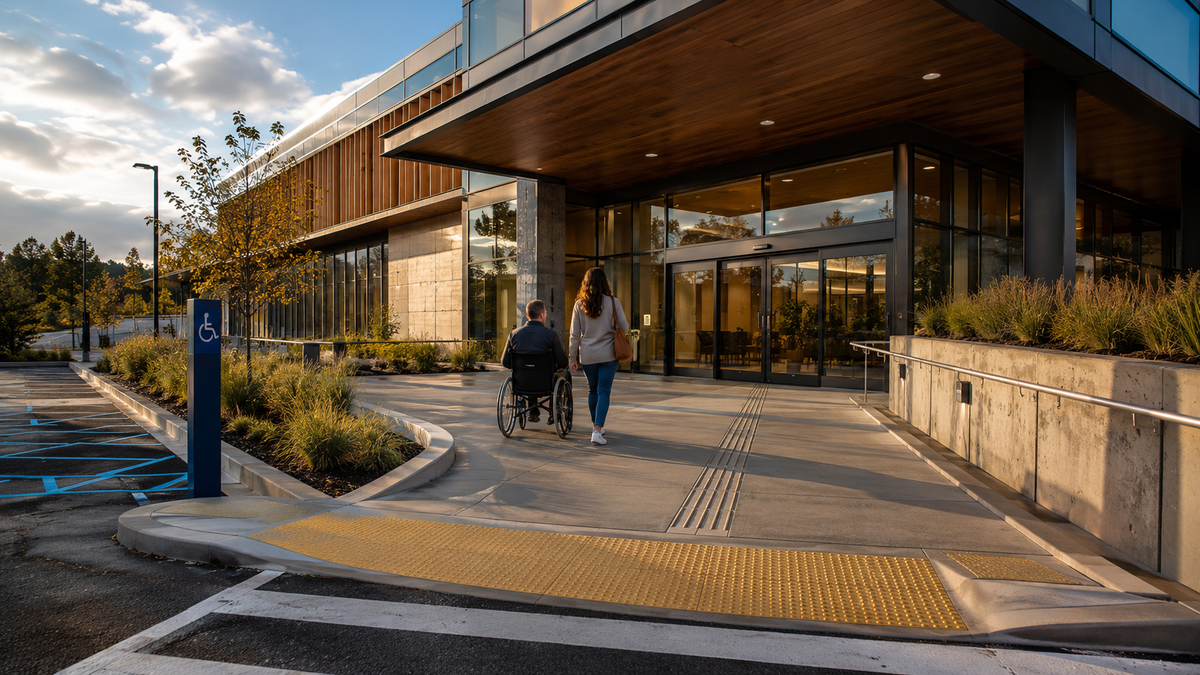
Physical accessibility is the design of buildings, routes, bathrooms, parking, and services so people with disabilities can enter, move through, and use spaces independently. It matters because access affects mobility, health, employment, and participation in everyday life.
Key Takeaways
- Physical accessibility covers the full journey from arrival to the door and through the building, not just a ramp.
- According to the World Health Organization, more than 1.3 billion people globally live with a disability, so access is a major public issue.
- According to the U.S. Bureau of Labor Statistics, people with disabilities made up about 13% of the U.S. population in 2025 but had a 22.8% employment rate.
- According to the National Center for Health Statistics, adults without disabilities were more than twice as likely to meet aerobic guidelines in 2026.
- Angela Fowler's course gives a practical, common-sense way to turn accessibility ideas into action.
Table of Contents
- Understanding Physical Accessibility
- Key Concepts and Techniques
- Who Benefits from Learning Physical Accessibility?
- What Do Students Say?
- About the Creator
- Physical Accessibility Essentials Table
- Watch Before You Enroll
- Frequently Asked Questions
- Conclusion
- Explore More on TGD
Understanding Physical Accessibility
Physical accessibility is the set of design choices that lets people enter, move through, and use spaces independently. It includes routes from parking lots or transit stops, entrances, restrooms, counters, and interior circulation. According to the U.S. Access Board, at least one accessible route must connect arrival points to accessible entrances and then to accessible spaces inside.
It matters because accessibility affects whether people can participate in daily life on equal terms. According to the World Health Organization, more than 1.3 billion people globally have a disability. In the United States, the Bureau of Labor Statistics reported in 2025 that people with disabilities were about 13% of the population, yet only 22.8% were employed compared with 65.2% of people without disabilities. The 2026 National Center for Health Statistics brief also found a major activity gap: 49.8% of adults without disabilities met aerobic guidelines, compared with 22.4% of adults with disabilities. That gap shows physical access is not cosmetic. It shapes health, independence, and economic participation.
Want to Learn Physical Accessibility Step by Step?
This course on The Great Discovery covers the fundamentals and practical examples you just learned.
Key Concepts and Techniques
Physical accessibility works best when the whole path is usable, not just one feature. The most useful concepts are continuous routes, independent entry, clear interior movement, and systems that adapt as standards evolve.
Accessible Routes
An accessible route is the continuous path that connects arrival points to the entrance and then to usable spaces inside. The U.S. Access Board emphasizes that this route should link parking, streets, sidewalks, and transit stops to the building.
In practice, that means checking slopes, surface changes, curb ramps, and obstructions. A route can look compliant on paper and still fail if a rolling user has to detour around a planter, step, or locked gate.
Independent Entrances and Thresholds
An accessible entrance should not require special assistance. Automatic doors, level thresholds, clear hardware, and visible signage reduce friction for wheelchair users, older adults, parents with strollers, and anyone carrying items.
Small design details matter here. A doorway that is technically wide enough still fails if the threshold is too high or the handle is hard to grip.
Restrooms and Interior Clearance
Bathrooms often determine whether a space is truly usable. Turning space, grab bars, sink clearance, and reachable fixtures matter because a person may otherwise reach the building but still not be able to use it comfortably or safely.
Interior clearance also affects waiting areas, aisles, and service points. If there is no room to turn, pass, or approach a counter, the rest of the space loses practical value.
Future-Proofing for Real Use Cases
Accessibility standards keep expanding because real-world needs change. According to the International Code Council, the 2026 A117.1 update adds criteria for adult changing stations, assisted-toileting and bathing, and self-service checkout counters.
That is a good reminder that access is broader than ramps and door widths. A practical accessibility plan looks at how people actually use a space today, not only how the code treated access years ago.
Who Benefits from Learning Physical Accessibility?
Physical accessibility matters to anyone who designs, manages, or relies on public space. It is also useful for people who want a practical lens on inclusion rather than a purely legal one.
Business owners and operators
If you own a storefront, office, gym, or venue, accessibility affects traffic and customer independence. The course sits in Entrepreneurship and Business, Health and Fitness, Professional Studies, and TGD Success, and the provided data does not list a skill level or price.
If you want a practical starting point, Angela Fowler's TGD course is a useful place to begin because it focuses on common-sense accessibility solutions.
Facility and property teams
Property managers, architects, contractors, and maintenance teams need to turn standards into details people can actually use. The U.S. Access Board guidance is only helpful when it becomes an entrance, route, restroom, or counter that works in the real world.
Angela Fowler's course is a good fit for this audience because it emphasizes practical fixes over jargon-heavy theory.
Health, fitness, and community leaders
Accessibility also affects participation in movement and wellness. According to the National Center for Health Statistics, adults without disabilities were more than twice as likely to meet aerobic guidelines as adults with disabilities, so the built environment matters.
Leaders in health, fitness, and community programming can use accessibility thinking to remove barriers before they become exclusion.
Advocates and learners
Students in Professional Studies or TGD Success can use this topic to build a baseline of access literacy. According to the World Health Organization, more than 1.3 billion people globally have a disability, so the audience is broad.
Even if you are starting from scratch, this topic gives you a concrete framework for noticing barriers and explaining them clearly to others.
What Do Students Say?
This course is new to the marketplace and hasn't collected reviews yet. Check back after launch for student feedback.
About the Creator
Angela Fowler is the creator behind this course. Her stated bio is common-sense accessibility solutions, and the available creator data shows 4 courses created, 9 total learners, and an average rating of 0.0.
View the creator profile at Angela Fowler on The Great Discovery.
Physical Accessibility Essentials Table
These are the core features that make a space usable for more people. Each one affects independence, safety, and dignity in a different part of the built environment.
| Feature | What It Supports | Practical Check |
|---|---|---|
| Accessible route | Continuous travel from arrival to destination | Check slope, width, surface, and obstruction-free travel. |
| Entrances | Independent entry into the building | Use level thresholds, automatic doors, and clear signage. |
| Restrooms | Private use and dignity | Provide turning space, grab bars, and reachable fixtures. |
| Parking and drop-off | Safe arrival from a car or ride service | Keep accessible spaces close and connected to curb ramps. |
| Service counters and checkouts | Buying, asking questions, and getting help | Include a lowered surface or an accessible self-service option. |
| Adult changing and assisted-care spaces | Longer visits and broader care needs | Plan for space, privacy, and clear wayfinding. |
This table is useful because it turns an abstract topic into a quick inspection list. Angela Fowler's course is a strong follow-up if you want to translate these checks into practical improvements in real spaces.
Master Physical Accessibility with Expert Guidance
Angela Fowler's common-sense accessibility approach pairs well with the checklist you just reviewed. This course covers those ideas in a structured format you can work through at your own pace.
Enroll in Access for Everyone: Physical Accessibility →
Watch Before You Enroll
Watch this short video overview to understand the main ideas behind Access for Everyone: Physical Accessibility before you enroll.
This video introduces Access for Everyone: Physical Accessibility and previews check out these statistics: So doesn't it make sense to make the physical world more accessible for everyone?.
Frequently Asked Questions
What is physical accessibility?
Physical accessibility is the design of environments so people can enter, move through, and use them independently. It covers sidewalks, parking, entrances, restrooms, counters, and interior circulation.
Why do accessible routes matter?
The U.S. Access Board says accessible routes must connect arrival points to accessible entrances and inside spaces. Without that continuous path, a building may be technically open but still not usable.
What features make a restroom accessible?
Common features include turning space, grab bars, reachable dispensers, and clear floor space at the sink and toilet. Restrooms are often where access fails, because a person may reach the building but still cannot use it.
How do accessibility standards change over time?
They change as technology and real-world use cases change. According to the International Code Council, the 2026 A117.1 update adds criteria for adult changing stations, assisted-toileting and bathing, and self-service checkout counters.
Who benefits most from physical accessibility?
Everyone benefits, but the need is especially clear for people with disabilities, older adults, and anyone with temporary mobility limits. According to WHO, more than 1.3 billion people globally have a disability, so this is a mainstream design issue.
Is the TGD course suitable for beginners, and is a price listed?
The supplied data does not list a skill level or price. The course is categorized under Entrepreneurship and Business, Health and Fitness, Professional Studies, and TGD Success, which suggests a practical cross-disciplinary fit.
Ready to Go Deeper?
You have learned the fundamentals of physical accessibility, from routes and entrances to restrooms and interior clearance. This course takes you from understanding to practical application.
Start Learning Physical Accessibility on TGD →
Conclusion
You learned that physical accessibility is the difference between a space that exists and a space people can actually use. It depends on connected routes, usable entrances, clear interior movement, accessible restrooms, and details that support independence. The research makes the case: according to WHO, more than 1.3 billion people globally have a disability, and U.S. data show major gaps in employment and physical activity. If you want to go from understanding to action, Access for Everyone: Physical Accessibility gives you a structured next step. Access the course here.
Explore More on TGD
If you want to keep learning, the fastest path is to browse TGD by category and follow the creator page. The links below give you a broader view of the catalog and the creator behind this course.
- Entrepreneurship and Business courses
- Health and Fitness courses
- Professional Studies courses
- TGD Success courses
- The Great Discovery homepage
- Angela Fowler creator page
Share Your Knowledge on The Great Discovery
Join Angela Fowler and hundreds of other creators sharing their expertise. Create and sell your own courses on TGD.