
Halloween English Vocabulary & Simple Conversations for Beginners
Halloween vocabulary refers to the English words and phrases related to Halloween traditions, costumes, and celebrations. Simple conversations practice involves using these words in basic dialogues and everyday interactions, helping learners build confidence speaking English in familiar contexts.
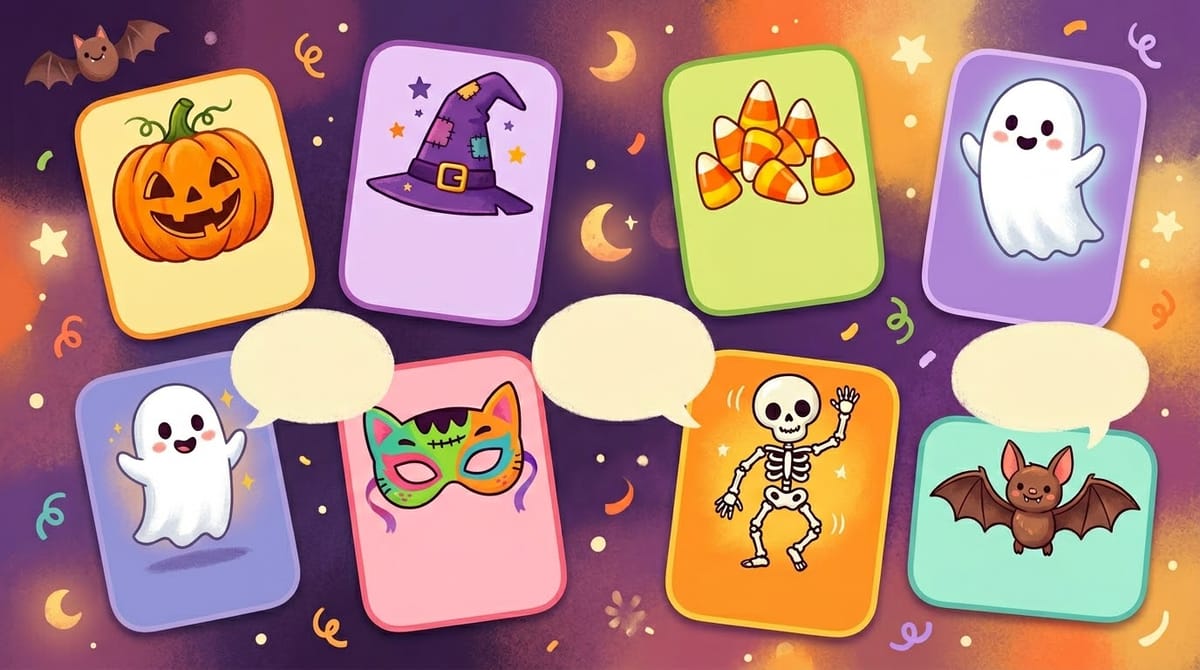
Halloween vocabulary refers to the English words and phrases related to Halloween traditions, costumes, and celebrations. Simple conversations practice involves using these words in basic dialogues and everyday interactions, helping learners build confidence speaking English in familiar contexts.
Key Takeaways
- Learn 25+ essential Halloween-related English words and phrases used in real conversations
- Practice speaking through thematic scenarios that make language memorable and applicable
- Understand Halloween traditions and cultural context in English-speaking communities
- Build vocabulary retention through engaging, emotionally relevant content
- Gain confidence speaking English in a low-pressure, fun learning environment
Table of Contents
- Understanding Halloween Vocabulary and Simple Conversations
- Key Concepts and Techniques
- Who Benefits from Learning Halloween English?
- What Do Students Say?
- About the Creator
- Essential Halloween Vocabulary and Concepts
- Watch Before You Enroll
- Frequently Asked Questions
- Conclusion
- Explore More on TGD
Understanding Halloween Vocabulary and Simple Conversations
Halloween vocabulary forms a unique subset of English that combines seasonal words, cultural traditions, and playful language. Learning Halloween-specific terms provides English learners with both practical vocabulary for seasonal communication and cultural insight into how English-speaking communities celebrate this autumn festival.
This vocabulary spans traditional elements like costumes, decorations, treats, and activities, as well as modern expressions used in contemporary Halloween celebrations. From "trick-or-treat" and "jack-o'-lantern" to "spooky" and "haunted house," each word carries cultural significance that helps learners understand not just language, but the traditions behind it.
Simple conversation practice around Halloween themes offers learners a relatable, engaging context for building speaking skills. Rather than abstract grammar exercises, learners practice actual dialogues they might encounter: discussing costume plans, decorating strategies, or asking about Halloween traditions. This contextual learning makes language acquisition more memorable and immediately applicable.
Want to Learn Halloween English Step by Step?
This free course on The Great Discovery covers all the fundamental vocabulary and conversation patterns you need to discuss Halloween confidently in English.
Key Concepts and Techniques
Thematic Vocabulary Clustering
Rather than learning random words, effective Halloween vocabulary instruction groups related terms by context: costumes, decorations, treats, activities, and emotions. This clustering approach helps learners retain vocabulary more effectively because related words reinforce each other, making it easier to recall "vampire" when discussing "zombie" or "ghost."
Dialogue-Based Conversation Practice
Real conversation typically follows predictable patterns. A typical Halloween conversation might ask about costume plans, exchange candy preferences, or discuss party attending. By practicing these recurring dialogue structures, learners build automaticity—they can respond naturally rather than translating word-by-word in their minds.
Cultural Context Integration
Vocabulary becomes meaningful when learners understand why it matters. Learning that "jack-o'-lantern" references an Irish folklore legend, or that "trick-or-treating" originated from ancient Celtic customs, creates emotional engagement and deeper memory formation compared to pure vocabulary memorization.
Pronunciation and Natural Speech Patterns
Many Halloween words have specific pronunciation challenges: the "th" in "the haunted house," the "gh" sound in "ghost," or the stress patterns in "skel-e-ton." Practicing these words in context helps learners develop natural English speech patterns rather than translating word-by-word from their native language.
Progressive Difficulty Scaffolding
Effective language learning introduces concepts in order from simplest to most complex. Beginners start with basic nouns and simple present-tense sentences ("I like Halloween"). As they progress, they move to more complex structures ("I'm dressing up as a vampire because I love spooky costumes"), building skills systematically.
Who Benefits from Learning Halloween English?
Young English Learners (Ages 6-12)
Children naturally engage with holiday and seasonal content. Halloween vocabulary provides young learners with practical words they encounter in real life during October, making language learning feel relevant and fun rather than abstract. The playful nature of the holiday makes grammar practice feel more like a game than a lesson.
Beginner-Level ESL Students
Learners starting their English journey benefit from thematic units because they provide a complete vocabulary set around a single concept. Rather than scattered individual words, students can build a coherent mental model of how to discuss one topic thoroughly, building confidence faster than with random vocabulary introduction.
Parents Teaching English at Home
Parents seeking resources for children's English development often struggle to find engaging content that maintains interest beyond a few lessons. This free course on The Great Discovery provides structured lessons parents can guide their children through, eliminating the planning burden while ensuring consistent quality instruction.
English Teachers Seeking Engaging Resources
Teachers need classroom materials that engage students while covering learning objectives. Seasonal content like Halloween vocabulary provides natural motivation and context that standard textbooks often lack, making it easier to maintain student interest during lessons and practice activities.
What Do Students Say?
This course is new to the marketplace and hasn't collected detailed student reviews yet. As learners progress through Nichole Antonio's Halloween vocabulary course, feedback will showcase how effective the structured conversation practice and thematic approach is for building English confidence. Check back after more students complete the course to see their experiences and results.
About the Creator
Nichole Antonio is a CoachSulting Specialist, Teacher, and Course Creator with extensive experience designing educational content. She maintains a perfect 5.0-star average rating on The Great Discovery and has created 12 courses that serve 22 learners across her platform. Her dual background in professional coaching and classroom teaching makes her well-positioned to create engaging, effective content that works both for individual learners and classroom environments.
Nichole's approach to language instruction emphasizes context, engagement, and practical application—which shows clearly in the Halloween vocabulary course's focus on real conversations and cultural understanding rather than rote memorization.
View more of Nichole Antonio's courses →

Essential Halloween Vocabulary and Concepts
| Halloween Element | English Vocabulary | Conversation Usage | Cultural Note |
|---|---|---|---|
| Costumes & Characters | Witch, vampire, ghost, skeleton, superhero, zombie | "I'm dressing up as a witch this year." | References folklore, horror, and pop culture |
| Decorations | Pumpkin, jack-o'-lantern, cobweb, bat, skeleton, cauldron | "We're hanging cobwebs on the porch." | Jack-o'-lanterns trace back to Irish tradition |
| Candy & Treats | Candy, chocolate, lollipop, popcorn ball, candy corn | "Can I have a piece of candy?" | Candy corn is uniquely American Halloween tradition |
| Activities | Trick-or-treat, carve, decorate, haunt, bobbing (apples) | "Do you want to go trick-or-treating?" | Trick-or-treating evolved from medieval customs |
| Adjectives & Feelings | Spooky, scary, creepy, eerie, frightening, fun, exciting | "That haunted house looks really spooky!" | Emotion words are crucial for conversation depth |
| Key Phrases | "Trick or treat!", "Happy Halloween!", "Boo!" | Children say "Trick or treat!" at neighbors' doors | Traditional greetings specific to the holiday |
This vocabulary table covers the core Halloween concepts learners encounter most frequently. Understanding these categories helps you recognize patterns in English: costume characters are nouns, decorations are objects you can interact with, and adjectives describe the emotional tone. By grouping related vocabulary this way, learners can build more sophisticated conversations by combining vocabulary from multiple categories—for example, describing a spooky ghost decoration or a fun superhero costume.
Master Halloween English with Expert Guidance
Nichole Antonio's course covers all of these vocabulary categories with structured lessons you can complete at your own pace, plus guided conversation practice that helps you use these words naturally in actual dialogue.
Enroll in Halloween Vocabulary & Simple Conversations →
Watch Before You Enroll
Learn how to become an affiliate on The Great Discovery—the best affiliate program for course creators and marketers in 2026. Start earning commissions by sharing courses you believe in.
Frequently Asked Questions
What is the best way to learn Halloween vocabulary?
The most effective approach combines multiple learning methods: hearing the words (listening to native speakers), reading them in context, writing them down, and speaking them aloud in real conversations. Spacing out your learning across multiple days and practicing consistently helps move vocabulary from short-term to long-term memory. Thematic learning—grouping all Halloween words together—is more effective than random vocabulary introduction because related words reinforce each other.
Why is seasonal vocabulary important for English learners?
Seasonal vocabulary provides learners with a complete, real-world context for language use. Unlike abstract textbook lessons, learning Halloween English connects to actual celebrations learners will experience, making language feel relevant and immediately applicable. This emotional engagement creates stronger memory formation and higher motivation to practice.
How can children practice Halloween conversations naturally?
The most natural practice happens through actual conversations about Halloween: discussing costume ideas, asking about favorite decorations, or talking about trick-or-treating plans. Structured dialogue practice in courses helps, but the ultimate goal is real-world conversation. Parents can support this by having natural discussions about Halloween plans in English rather than treating language practice as separate from actual celebration planning.
What are the most important Halloween words to know?
The highest-priority vocabulary for Halloween conversations includes costume names (witch, ghost, vampire), decoration words (pumpkin, cobweb), key activities (trick-or-treat, carve), and emotion adjectives (spooky, scary, fun). These core words appear in most Halloween conversations, so mastering them gives learners the foundation to understand and participate in typical seasonal discussions.
How does Halloween differ in different English-speaking countries?
While Halloween traditions vary, the core English vocabulary remains consistent across countries. Americans emphasize trick-or-treating and jack-o'-lanterns, while UK traditions focus on bonfire night and fireworks (though Halloween celebrations are growing). Understanding these cultural variations enriches vocabulary learning because learners see how context changes word usage and importance, deepening their understanding of the language.
Is this course free, and what's the time commitment?
Yes, this course is completely free on The Great Discovery. The course is designed for basic-level learners and self-paced, so you can complete lessons based on your own schedule. Most learners spend 30-60 minutes per week on the material, though you can move faster or slower depending on your learning style and availability.
Ready to Go Deeper?
You've learned the fundamentals of Halloween vocabulary and conversation patterns. This free course takes you from understanding the words to confidently using them in real conversations.
Start Learning Halloween English on TGD →
Conclusion
Halloween vocabulary represents more than just a collection of seasonal words—it's a gateway to understanding English-speaking culture and building practical conversation skills in a real-world context. By learning thematic vocabulary and practicing simple conversations about recognizable traditions, learners accelerate their language acquisition because the content connects to actual experiences and emotional engagement.
Nichole Antonio's free course on The Great Discovery provides the structured guidance needed to move from understanding Halloween words to confidently using them in conversation. The course covers vocabulary, dialogue practice, and cultural context in an engaging format designed for basic-level learners. Whether you're a parent supporting a child's English development or an adult learner seeking practical speaking practice, this free course offers a clear, enjoyable path to Halloween English mastery.
Start your Halloween vocabulary journey today on The Great Discovery →
Explore More on TGD
- More Academic Learning Courses on TGD
- More Kids Content Courses on TGD
- More Parenting Resources on TGD
- Explore All Courses on The Great Discovery
- More Courses from Nichole Antonio
Share Your Knowledge on The Great Discovery
Join Nichole Antonio and hundreds of other creators sharing their expertise. Create and sell your own courses on TGD.