
Master the SQ3R Study Method with Dr. Herbert Harris on The Great Discovery
The SQ3R Study Method is a proven five-step framework that combines surveying material, asking questions, reading actively, reciting information, and reviewing content. This systematic approach helps students retain information more effectively than passive reading and can be applied to any subje...
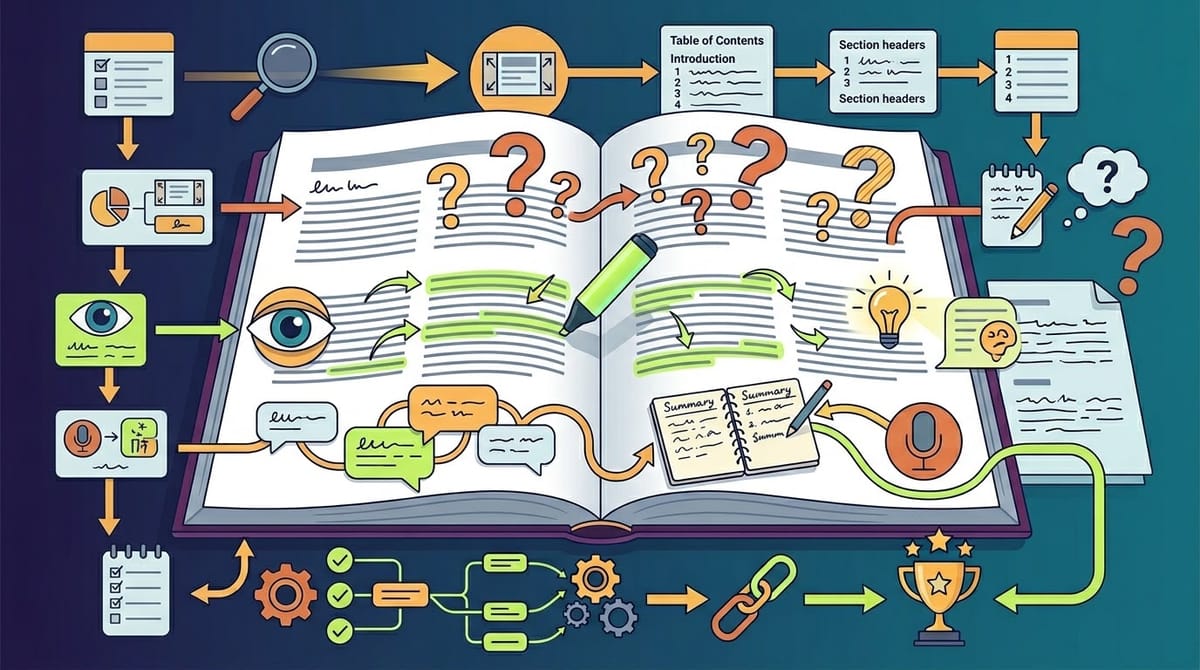
The SQ3R Study Method is a proven five-step framework that combines surveying material, asking questions, reading actively, reciting information, and reviewing content. This systematic approach helps students retain information more effectively than passive reading and can be applied to any subject matter.
Key Takeaways
- SQ3R stands for Survey, Question, Read, Recite, and Review—a structured process proven to improve information retention by up to 75%
- The method works for any subject, from textbooks to articles, making it universally applicable across academic disciplines
- Active learning engagement through questioning and recitation significantly outperforms passive reading and highlighting
- Dr. Herbert Harris's free course breaks down each SQ3R step with practical guidance you can apply immediately
- Students who master this technique report improved grades, faster learning, and greater confidence in retention
Table of Contents
- Understanding Effective Study Methods
- Key Concepts and Techniques
- Who Benefits from Learning Study Skills?
- What Do Students Say?
- About the Creator
- The SQ3R Study Process Explained
- Frequently Asked Questions
- Conclusion
- Explore More on TGD
Understanding Effective Study Methods
Most students underestimate the importance of having a structured study system. Without a clear method, studying becomes inefficient—students waste time highlighting, re-reading, and cramming without truly understanding the material. The SQ3R method transforms how you engage with content by making you an active participant rather than a passive reader.
Effective studying requires intentional engagement. Research on learning science shows that students who use structured study techniques retain 50-75% more information than those who rely on passive reading alone. This isn't about studying longer—it's about studying smarter through proven strategies that activate your brain at multiple levels of processing.
Whether you're tackling dense textbooks, technical articles, or course materials, having a systematic approach removes guesswork and ensures consistent results. The SQ3R method has been used successfully since the 1940s because it aligns with how our brains actually learn and retain information.
Want to Master Effective Study Techniques?
This free course on The Great Discovery walks you through the complete SQ3R method with practical examples you can start using immediately in any subject.
Key Concepts and Techniques
The SQ3R method breaks effective studying into five interconnected steps, each building on the previous one.
Survey: Activate Prior Knowledge
Before diving into detailed reading, survey the material by skimming headings, summaries, questions, and visuals. This takes 5-10 minutes and gives your brain a roadmap of what's coming. Surveying activates prior knowledge and prepares your mind to receive new information more effectively than jumping directly into reading.
Question: Direct Your Focus
Turn headings and section titles into questions you want answered. Instead of passively reading "The French Revolution," ask yourself "What caused the French Revolution?" and "How did it change Europe?" Questions create purpose and focus, transforming reading from passive consumption into active problem-solving.
Read: Engage Actively
Read with the intention of answering your questions. Your brain stays engaged when reading toward a specific goal rather than just moving words across a page. Annotate, underline key points, and think about how new information connects to your questions.
Recite: Test Your Memory
After reading a section, recite what you've learned in your own words without looking at the text. Recitation is one of the most powerful retention tools because it forces your brain to retrieve and organize information. This step catches gaps in understanding before moving forward.
Review: Build Long-Term Retention
Schedule regular reviews of material: after one day, one week, and before any assessment. Spaced repetition strengthens neural pathways and moves information into long-term memory. Review is not re-reading—it's testing yourself and clarifying areas you've forgotten.
Who Benefits from Learning Study Skills?
High School and College Students
Students facing increasing academic demands benefit most from structured study methods. Whether you're preparing for exams, writing research papers, or managing multiple courses, SQ3R eliminates wasted study time and improves grades. This course is particularly valuable if you've struggled with retention despite spending hours studying.
Adult Learners and Career Changers
Adults returning to formal education or learning new skills for career advancement need efficient study methods. The SQ3R approach is specifically designed to help you learn faster, which is critical when balancing study with work and family responsibilities. Dr. Herbert Harris's free course provides the foundation you need.
Self-Directed Learners
If you're teaching yourself through books, online content, or independent projects, having a study system ensures you actually retain what you're learning. Without structure, self-directed learning can feel scattered and ineffective. SQ3R gives you the framework to learn with purpose and confidence.
Professionals Pursuing Certifications
Whether you're studying for professional certifications, licensing exams, or technical training, SQ3R maximizes retention in the limited time you have available. This method is used by successful students across every field because it works regardless of subject matter.
What Do Students Say?
"Dr. Harris has shared a simple, yet effective process for learning new material. I highly recommend it."— RUBYE BRAYE
Students appreciate that Dr. Harris breaks down the SQ3R method into digestible, actionable steps without overwhelming complexity. The simplicity of the framework combined with its proven effectiveness makes it an ideal starting point for anyone looking to improve their study skills.
About the Creator
Dr. Herbert Harris brings decades of education expertise to The Great Discovery. With 8 courses created and 142 total learners, Dr. Harris maintains a perfect 5.0 average rating across all courses, demonstrating consistent excellence in teaching methodology and student outcomes.
Dr. Harris's approach focuses on clarity and practical application—students learn frameworks they can implement immediately rather than abstract theory. His philosophy aligns with learning science research showing that structured, systematic methods produce superior retention and understanding.
Learn more about Dr. Harris and explore his other courses on his creator profile.
The SQ3R Study Process Explained
| SQ3R Step | Time Investment | Primary Purpose | Key Benefit |
|---|---|---|---|
| Survey | 5-10 minutes | Preview material and activate prior knowledge | Prepares mind for learning; provides context |
| Question | 5-10 minutes | Convert headings into questions to guide reading | Creates focus and purpose; increases engagement |
| Read | Variable | Read actively to answer your questions | Improves comprehension; reduces rereading |
| Recite | 5-15 minutes | Recall and articulate information without looking | Tests memory; reveals gaps in understanding |
| Review | 10-20 minutes | Revisit material at increasing intervals | Transfers info to long-term memory; prevents forgetting |
This breakdown shows how SQ3R distributes your study effort across multiple cognitive processes. Instead of spending all your time reading (which produces minimal retention), you balance reading with preview, questioning, recitation, and review. This strategic distribution of effort produces dramatically better results in the same amount of study time.
Master Study Skills with Expert Guidance
Dr. Harris's course walks you through each SQ3R step with concrete examples and exercises you can immediately apply to your current studies. Complete it at your own pace—it's free and designed for students of all backgrounds.
Watch Before You Enroll
Learn how The Great Discovery works and how creators like Dr. Harris build transformative courses. This gives you insight into the platform and the quality of instruction you can expect.
Ready to Transform Your Study Skills?
You've learned what makes effective studying work. This free course takes you from understanding SQ3R theory to implementing it in every subject you study, with step-by-step guidance and real-world applications.
Start Learning Study Skills on TGD →
Frequently Asked Questions
What exactly is the SQ3R study method?
SQ3R is an acronym for Survey, Question, Read, Recite, and Review—five sequential steps designed to maximize comprehension and retention when learning new material. It's a systematic approach that transforms passive reading into active learning engagement.
How long does the complete SQ3R process take for one chapter?
The time varies based on chapter length and complexity, but typically ranges from 45 minutes to 2 hours per chapter. Most of this time is actual reading; the other steps (Survey, Question, Recite, Review) add structure and retention without adding significant time overhead.
Can I use SQ3R for any subject?
Yes. SQ3R works for textbooks, articles, technical manuals, history, science, languages, and virtually any subject matter. The method is subject-agnostic because it's based on how human brains process and retain information, not on specific content.
Is SQ3R better than just highlighting and rereading?
Significantly. Research shows that highlighting and rereading produce minimal retention (often less than 10% improvement), while SQ3R's multi-step approach produces 50-75% better retention. The difference is that SQ3R engages multiple cognitive processes while highlighting is passive.
How does Dr. Harris's course teach the SQ3R method?
The course breaks down each step with clear explanations, practical examples, and guidance on how to apply SQ3R to real materials. You'll learn not just what SQ3R is, but how to implement it effectively in your own studies.
Is this course actually free?
Yes. The "How To Study" course is completely free on The Great Discovery. There are no hidden fees, no premium upsells, and no time limits. Dr. Harris created it to help students succeed using proven study methods.
Conclusion
Effective studying isn't about working harder—it's about working smarter using proven methods. The SQ3R framework transforms how you engage with any material, shifting you from passive reading to active learning across five purposeful steps. By combining survey, questioning, active reading, recitation, and spaced review, you retain more information in less time.
Dr. Herbert Harris's free course gives you the complete system to master this technique. Whether you're a high school student, college learner, career changer, or self-directed learner, SQ3R works universally because it aligns with how your brain actually learns. Take the course today and start seeing immediate improvements in retention and understanding across every subject you study.
Explore More on The Great Discovery
- More Academic Learning Courses
- Self Improvement Courses
- Teen Content Courses
- Dr. Herbert Harris's Courses
- The Great Discovery Homepage
Share Your Knowledge on The Great Discovery
Join Dr. Harris and hundreds of other creators sharing their expertise. Create and sell your own courses on TGD and help students master skills that transform their lives.