
Yoga for the Mind with ELL GRANIEL | TGD
Guided meditation is a structured attention practice that uses breath, imagery, or a mantra to calm the mind, reduce stress, and improve focus. It can also support creativity and lucid dreaming by training awareness before sleep and during waking reflection.
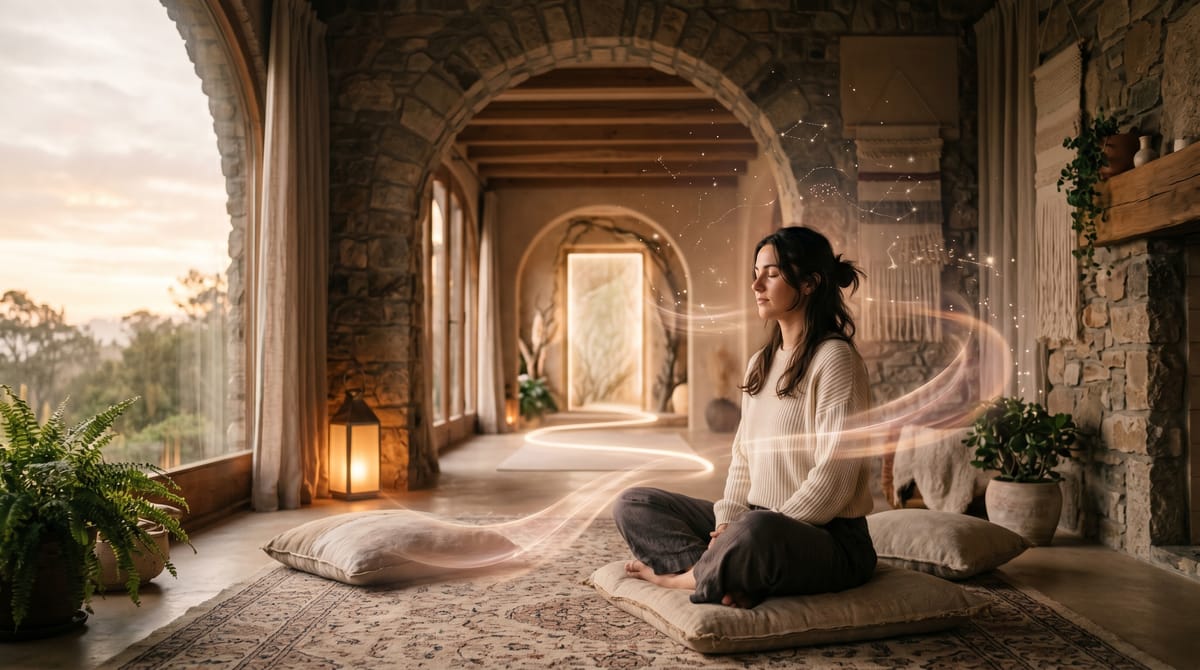
Guided meditation is a structured attention practice that uses breath, imagery, or a mantra to calm the mind, reduce stress, and improve focus. It can also support creativity and lucid dreaming by training awareness before sleep and during waking reflection.
Key Takeaways
- Meditation use in the U.S. rose from 7.5% of adults in 2002 to 17.3% in 2022, according to NCCIH/NHIS 2022.
- NCCIH defines meditation as a family of practices that uses breathing, sound, imagery, or mantra to calm the mind and support well-being.
- A 111-RCT meta-analysis found mindfulness-based interventions produced small-to-moderate gains in cognition, attention, and working memory.
- A 2024 Frontiers in Psychology study linked mindfulness and creativity through psychological capital in 894 Hong Kong secondary-school students.
- Yoga for the Mind on The Great Discovery bundles relaxation, creative thinking, and lucid-dream practice into one guided path.
Table of Contents
- Understanding Guided Meditation for Relaxing, Creative Thinking, and Lucid Dreaming
- Key Concepts and Techniques
- Who Benefits from Learning Guided Meditation?
- What Do Students Say?
- Is This Course Worth It?
- About the Creator
- Meditation Practices That Build Calm, Creativity, and Dream Awareness
- Watch Before You Enroll
- Frequently Asked Questions
- Conclusion
- Explore More on TGD
Understanding Guided Meditation for Relaxing, Creative Thinking, and Lucid Dreaming
Guided meditation is a family of practices that calms attention through a repeated anchor. According to NCCIH, the anchor may be the breath, a sound, a visual image, or a mantra. That matters because the method is simple enough for beginners and flexible enough for daily use.
In the U.S. National Health Interview Survey data cited by NCCIH, meditation use rose from 7.5% of adults in 2002 to 17.3% in 2022, making it the most-used complementary health approach in that survey. Guided imagery and progressive muscle relaxation also increased from 3.8% to 6.4%. The trend suggests people want accessible tools for stress, focus, and emotional reset. Guided meditation matters because it gives those tools a repeatable format anyone can practice with a few quiet minutes and no equipment.
Want to Learn Guided Meditation Step by Step?
This course on The Great Discovery covers these fundamentals in a more structured format.
The Great Discovery (TGD) is a global online course marketplace where creators publish courses and learners discover practical training across business, technology, wellness, and personal growth.
Key Concepts and Techniques
Guided meditation works best when it gives the mind one clear job at a time. The most useful techniques build from that simple idea into repeatable routines for relaxation, self-observation, and dream awareness.
Breath Anchoring
Breath anchoring means using the inhale and exhale as a stable point of attention. When your mind wanders, you return to the breath without judging the drift, which is the real repetition that trains focus.
Body Scan Relaxation
A body scan moves attention through the body in sequence, often from the face down to the feet. It helps you notice tension that you would otherwise ignore, and it pairs well with progressive muscle relaxation when you want a deeper physical reset.
Guided Imagery for Creative Thinking
Guided imagery uses mental scenes, symbols, or prompts to help ideas surface in a less pressured way. A 2024 Frontiers in Psychology study of 894 Hong Kong secondary-school students suggests mindfulness can support creativity by strengthening the conditions for divergent thinking and problem solving.
Mantra Repetition
A mantra gives the mind a sound or phrase to return to when thoughts get noisy. It can be especially useful if quiet breathing alone feels too abstract, because the repetition creates a clear rhythm that is easy to hold.
Dream Recall and Wind-Down Practice
Lucid dreaming starts with awareness before sleep, not only inside the dream. A calmer evening routine, a brief reflection on the day, and a dream journal can improve recall and make lucidity more likely over time.
Who Benefits from Learning Guided Meditation?
Guided meditation helps people who want calm, focus, and a repeatable way to train attention. It is especially useful when you need a practical routine instead of abstract advice. The course also fits the Spiritual Growth, Self Improvement, Teen Content, and TGD Success categories, which signals a broad, self-development-focused audience.
Busy Professionals and Students
If your attention is split across deadlines, notifications, and mental overload, a guided practice gives you a clean reset. The structure matters because it removes decision fatigue; you only have to follow the next cue.
Creatives and Problem Solvers
Creativity often improves when the mind is calm enough to make unusual connections. The 2024 Hong Kong study with 894 students suggests mindfulness can support creativity through psychological capital, so a guided practice can be a useful pre-work routine for writing, design, or strategy.
Teens and First-Time Meditators
New learners often need simple language and a short sequence they can repeat. That makes this course's guided format and teen-friendly category especially approachable for people who want a gentle entry point without a steep learning curve.
Dream Explorers and Reflective Learners
If you are interested in dreams, symbolism, or sleep awareness, guided meditation can be a practical first step. A 2025 review of 38 lucid-dreaming studies found the field promising for nightmares and PTSD-related distress, and a structured course is a sensible way to build the basics.
What Do Students Say?
This course is new to the marketplace and hasn't collected reviews yet. Check back after launch for student feedback.
Is This Course Worth It?
Yes, if you want a guided introduction to meditation that connects relaxation, creativity, and lucid-dream practice.
It is best for learners who want step-by-step structure and a single place to explore attention, imagery, and dream awareness. The course's early learner signal and focused topic suggest it is built for people who prefer practical guidance over theory-heavy study.
It is not the best fit if you want a clinical program or a deep academic survey of meditation research. As a next step on TGD, it makes the most sense when you already know the basics and want a calm, repeatable practice you can actually keep using.
About the Creator
ELL GRANIEL is the creator of this course. Courses created: 1. Total learners: 16. Average rating: 0.0. No creator bio is listed yet, so the strongest signal here is a focused first-course profile with a small but real learner base. Visit the creator page.
Meditation Practices That Build Calm, Creativity, and Dream Awareness
| Practice | What It Does | Why It Matters |
|---|---|---|
| Breath anchoring | Uses the breath as a stable point of return | Trains attention without adding complexity |
| Body scan | Moves attention through the body in sequence | Helps spot tension and reduce physical stress |
| Guided imagery | Uses mental scenes or symbols to prompt ideas | Supports creative thinking and softer problem solving |
| Mantra repetition | Repeats a word or phrase to hold focus | Gives the mind a simple rhythm when thoughts are noisy |
| Dream journaling | Records dream fragments right after waking | Improves recall and helps you notice dream patterns |
| Evening wind-down | Uses a calm pre-sleep routine before bed | Supports sleep awareness and lucid-dream preparation |
These practices are easy to combine, which is why a guided course can help you keep the sequence consistent. Yoga for the Mind is useful if you want a single path instead of scattered tips.

Master Guided Meditation with Expert Guidance
ELL GRANIEL's course covers these concepts and more, with structured lessons you can complete at your own pace.
Enroll in Yoga for the Mind: Guided Meditation for Relaxing, Creative Thinking & Lucid Dreaming →
Watch Before You Enroll
Learn how to become an affiliate on The Great Discovery — the best affiliate program for course creators and marketers in 2026. Start earning commissions by sharing courses you believe in.
Frequently Asked Questions
What is guided meditation?
Guided meditation is a practice where a voice or script directs attention with breath, imagery, a sound, or a mantra. According to NCCIH, meditation is used to calm the mind and support well-being.
How can meditation help with stress?
Meditation can lower mental noise by giving attention one stable anchor to return to. NCCIH notes that meditation use in U.S. adults rose to 17.3% in 2022, which shows how mainstream the practice has become.
Can guided meditation improve creativity?
It can support the conditions that creative thinking needs, especially calm attention and flexible thinking. A 2024 Frontiers in Psychology study of 894 Hong Kong secondary-school students linked mindfulness and creativity through psychological capital.
What is lucid dreaming?
Lucid dreaming is the experience of knowing you are dreaming while the dream is happening. A 2025 review screened 1,247 records and included 38 studies, finding promise for nightmares and PTSD-related distress.
How do I start a guided meditation practice?
Start with 5 to 10 minutes, a comfortable seat, and one attention anchor such as breathing. If your mind wanders, return to the anchor without judgment; that repeat-and-return loop is the core skill.
What does the TGD course cover?
Yoga for the Mind focuses on relaxation, creative thinking, and lucid dreaming through guided meditation. It is a practical starting point if you want a structured path instead of piecing practices together on your own.
Ready to Go Deeper?
You've learned the fundamentals of guided meditation, plus how it can support creativity and dream awareness. This course takes that foundation and turns it into a guided practice you can use consistently.
Start Learning Guided Meditation on TGD →
Conclusion
Guided meditation is a practical way to train attention, reduce mental noise, and support clearer thinking. The research picture is encouraging: meditation use keeps rising, mindfulness-based interventions show cognitive gains, creativity links are emerging, and lucid-dreaming research is expanding. If you want those ideas organized into a single routine, Yoga for the Mind gives you a structured next step on The Great Discovery. That makes it a useful bridge between understanding the practice and actually doing it consistently. Start learning Yoga for the Mind on TGD →
Explore More on TGD
If you want to keep exploring, start with the categories that match this course's themes, then visit the creator page for more context.
- Spiritual Growth courses
- Self Improvement courses
- Teen Content courses
- TGD Success courses
- The Great Discovery homepage
- ELL GRANIEL creator page
Share Your Knowledge on The Great Discovery
Join ELL GRANIEL and hundreds of other creators sharing their expertise. Create and sell your own courses on TGD.